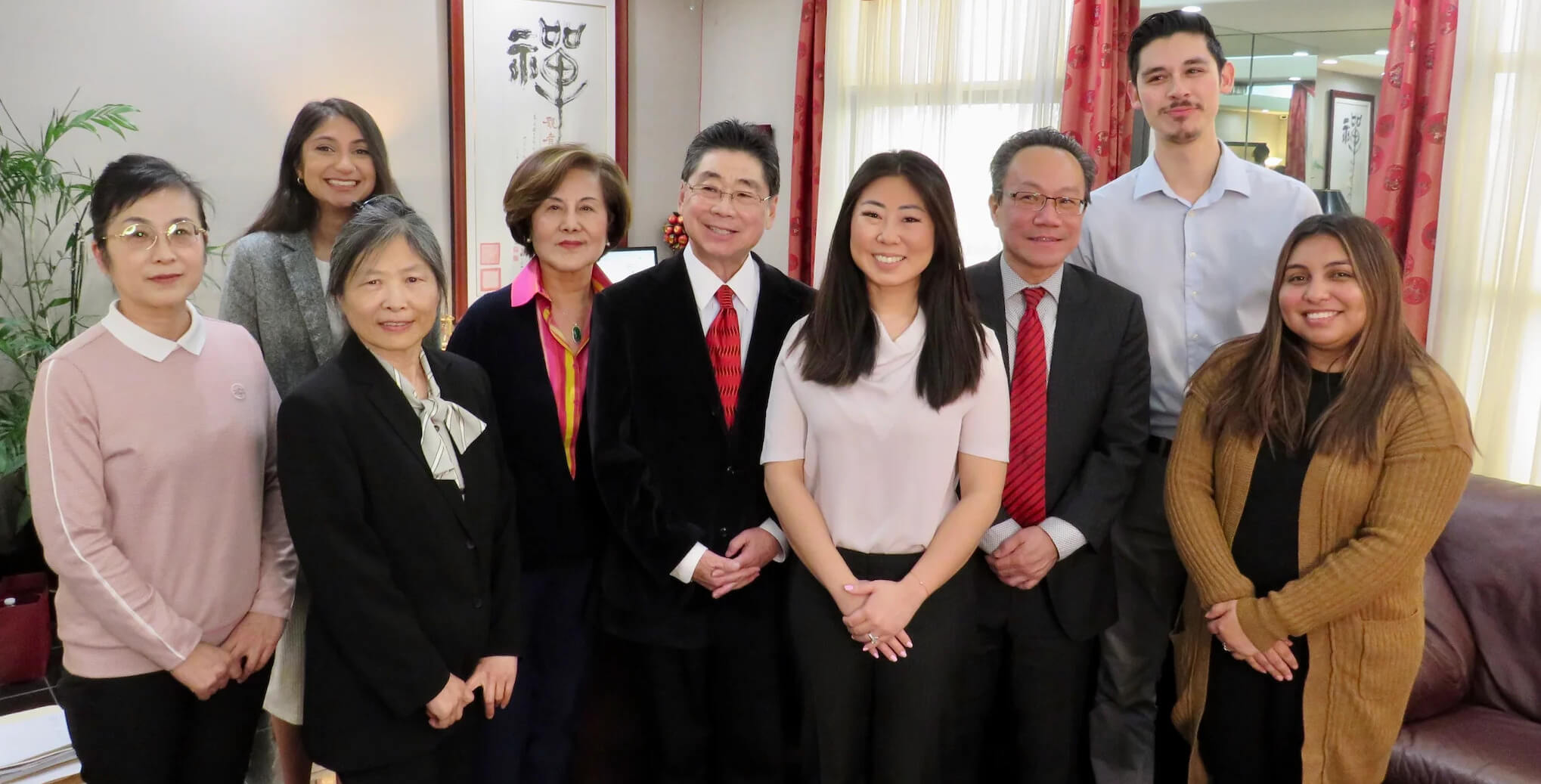

Why Choose Us?

  • Unmatched Expertise

    Trust in Peter Chu's 75+ years of collective experience to guide you through complex immigration matters.

  • Tailored Solutions

    Our personalized strategies adapt to your unique circumstances, ensuring we meet your specific immigration needs.

  • Proven Success

    Benefit from our solid track record in achieving favorable outcomes in various immigration cases across San Diego.

  • Dedicated Service

    Experience our client-first approach that ensures constant support and guidance throughout your immigration journey.

Ontario, CA sits at the intersection of three major Southern California counties, with over 180,000 residents and one of the highest immigrant population percentages in the Inland Empire. Approximately 44% foreign-born according to 2024 Census estimates. For families navigating F-2A visa petitions to reunite spouses and children of permanent residents in Ontario, the difference between approval and prolonged separation often comes down to whether USCIS received properly documented derivative beneficiary evidence before the priority date became current. Law office of Peter Darwin Chu has guided Ontario families through F-2A petitions since our founding, bringing California-licensed immigration expertise to one of the state's most diverse communities.

Book a Consultation

Law office of Peter Darwin Chu provides F-2A lawyer services to Ontario, CA residents. California State Bar licensed immigration attorneys representing spouses and children of lawful permanent residents in family-based visa petitions, with consultation appointments available within 48 hours and case management accessible online. Our Ontario practice focuses exclusively on immigration law, ensuring every F-2A petition receives the specialized attention required for USCIS approval.

F-2A Lawyer Ontario Available Across Ontario and Surrounding Areas

Law office of Peter Darwin Chu serves F-2A visa clients throughout Ontario, CA and surrounding Inland Empire communities. Including neighborhoods across zip codes 91758, 91761, 91762, 91764, and 91798, as well as adjacent areas in Rancho Cucamonga, Chino, and Upland. All immigration consultations are conducted by California-licensed attorneys familiar with the USCIS Los Angeles Field Office processing procedures that govern Ontario-based petitions.

What Ontario Residents Can Access

F-2A Spouse & Children of Permanent Residents Ontario

The F-2A category allows U.S. lawful permanent residents (green card holders) to petition for their spouse and unmarried children under 21. Unlike immediate relative petitions, F-2A applications are subject to annual visa number limitations and priority date queues. Currently averaging 18–24 months for most countries of chargeability, though significantly longer for high-demand countries. Ontario families benefit from our experience preparing I-130 petitions with complete bona fide relationship evidence that survives USCIS scrutiny at both the petition stage and the later consular interview. We coordinate every step from initial filing through final visa issuance.

Immigration Lawyer Ontario

Beyond F-2A petitions, our Ontario practice handles the full spectrum of family-based immigration. Including IR-1 Visa Family for immediate relatives, IR-2 Visa Unification for children of U.S. citizens, and F-1 Visa student status for those pursuing academic pathways. Our multi-visa expertise allows us to identify whether F-2A is truly the optimal category or whether an alternative pathway offers faster reunification.

F-2A Spouses & Children of Permanent Residents Ontario

Age-out protection under the Child Status Protection Act (CSPA) is critical for F-2A derivative beneficiaries approaching 21. Ontario families often underestimate how CSPA calculations work. The statute freezes a child's age based on a formula involving priority date wait time and I-130 pending time, not simply the child's biological age on approval date. We conduct CSPA analyses at petition filing to identify high-risk scenarios and recommend preemptive strategy adjustments, including whether the petitioning parent should naturalize to convert the case to an immediate relative category.

Get clear, expert legal guidance tailored to your visa, green card, or citizenship needs.

Why Ontario Families Trust Our Immigration Practice

Law office of Peter Darwin Chu maintains all required California State Bar licenses and professional liability insurance, operating under the ethical standards established by the California Rules of Professional Conduct and the American Immigration Lawyers Association (AILA) practice guidelines. Our Ontario immigration practice has handled F-2A petitions across every USCIS service center and National Visa Center processing track, giving us the institutional knowledge to navigate the procedural variations that delay less experienced practitioners. We provide every client with direct attorney access. Not paralegal-only communication. And transparent fee agreements compliant with California Business and Professions Code Section 6140–6149.

Inquire now to check if you qualify

What if my F-2A child turns 21 before the visa becomes available in Ontario?

If your derivative child beneficiary turns 21 before the F-2A priority date becomes current, the Child Status Protection Act (CSPA) may still preserve their eligibility. But only if the CSPA calculation results in a frozen age below 21. The formula subtracts the number of days the I-130 was pending from the child's biological age on the date the priority date became current. Ontario families facing this scenario should request a CSPA analysis immediately, as missing the one-year deadline to seek visa issuance after CSPA age determination can forfeit protection. In cases where CSPA does not apply, the child ages out into the F-2B category (unmarried adult children of permanent residents), which has significantly longer wait times. Currently over seven years for most countries. If the petitioning parent naturalizes to U.S. citizenship before the child turns 21, the case can convert to the F-1 immediate relative category, eliminating the age-out risk entirely.

What if my F-2A priority date retrogresses while waiting in Ontario?

Priority date retrogression. When the State Department visa bulletin moves backward, making previously current dates unavailable again. Is a common occurrence in family-based preference categories, including F-2A. Ontario petitioners experiencing retrogression cannot take any action to accelerate the date; they must simply wait until forward movement resumes. However, this waiting period is an opportunity to update supporting documentation, renew expired passports, obtain updated police certificates, and ensure all derivative beneficiaries remain unmarried and under 21 (if CSPA applies). Retrogression does not invalidate the I-130 approval or reset your place in line. Your priority date remains locked. Monitoring the monthly visa bulletin and maintaining USCIS address updates are the only required actions during retrogression periods.

What if the Ontario USCIS office requests additional evidence for my F-2A petition?

A Request for Evidence (RFE) from USCIS means the examiner requires additional documentation to establish eligibility. Most commonly proof of the petitioner's permanent resident status, bona fide marital relationship evidence, or derivative beneficiary birth certificates with certified translations. Ontario families have exactly the response deadline stated in the RFE notice. Typically 87 days from the issue date. To submit the requested material. Failing to respond, or submitting an incomplete response, results in automatic denial of the I-130 petition. The quality of the RFE response often determines case outcome: submitting the minimum requested documents may result in approval, but a well-constructed response package that exceeds the RFE scope. Providing context, explanatory cover letters, and additional corroborating evidence. Significantly increases approval likelihood and reduces the chance of a second RFE.

What if my spouse and I married after I became a permanent resident in Ontario?

Lawful permanent residents who marry after obtaining their green card are fully eligible to file F-2A petitions for their new spouse and any stepchildren acquired through the marriage. There is no waiting period or bar on post-green-card marriages in the F-2A category. The critical requirement is proving the marriage is bona fide (genuine, not entered solely for immigration benefit) through joint financial records, cohabitation evidence, photographs, and affidavits from individuals with personal knowledge of the relationship. Ontario couples should begin gathering this documentation immediately after marriage, as USCIS applies heightened scrutiny to marriages formed after the petitioner obtained permanent residence. If the marriage occurred shortly after the petitioner's green card approval, expect additional RFEs and potentially a USCIS interview (Stokes interview) designed to test the authenticity of the relationship.

Comparing F-2A Representation Options for Ontario Families

Ontario families filing F-2A petitions face three primary options: self-filing using USCIS forms and online guides, hiring a notario or immigration consultant, or retaining a California-licensed immigration attorney. Self-filing is the lowest-cost option upfront. USCIS filing fees are the only expense. But carries the highest risk of procedural errors that result in RFEs, denials, or multi-year delays. Notarios and consultants (many operating in Ontario's immigrant communities) often charge attorney-comparable fees but are not licensed to practice law in California, cannot represent clients before USCIS or immigration court, and provide no malpractice insurance protection if the case is mishandled. Here's the honest answer: F-2A petitions involve priority date calculations, CSPA age-out analysis, and consular processing coordination that unlicensed providers rarely understand at the level required to avoid costly mistakes. A denied I-130 cannot simply be refiled without addressing the grounds for denial. It often requires a motion to reopen or appeal, which only licensed attorneys can file.

OptionUpfront CostCSPA ProtectionRFE Response QualityProfessional Liability Coverage
Self-Filing$535 (USCIS fee only)No legal analysisMinimal, often incompleteNone
Notario/Consultant$800–$2,000Rarely assessedTemplate-basedNone. Unlicensed
Licensed Attorney (Law office of Peter Darwin Chu)$2,500–$4,500 (varies by complexity)Full CSPA calculation and strategyTailored, evidence-supportedYes. California State Bar malpractice insurance

Get in touch

Frequently Asked Questions

Find answers to common questions about our services

  • F-2A processing timelines for Ontario, CA families consist of two phases: I-130 petition adjudication (currently 12–18 months at USCIS California Service Center) and priority date wait time (18–24 months for most countries, significantly longer for high-d

  • F-2A derivative beneficiaries (spouses and children abroad) cannot work in the U.S. while waiting for visa issuance. They must remain outside the country until the immigrant visa is approved and they complete consular processing. If the F-2A beneficiary i

  • Ontario petitioners filing F-2A petitions must submit: proof of petitioner's lawful permanent resident status (copy of green card front and back), marriage certificate with certified English translation if applicable, birth certificates for all derivative

  • The F-2A category is for spouses and children of lawful permanent residents (green card holders), while IR-1 is for spouses of U.S. citizens. The primary difference is wait time: IR-1 is an immediate relative category with no annual visa number cap or pri

  • Yes, F-2A petitions can be denied. Common denial grounds include: failure to prove the petitioner's lawful permanent resident status, insufficient evidence of bona fide marital relationship (USCIS suspects marriage fraud), failure to prove legal terminati

  • If the F-2A beneficiary is found inadmissible during consular processing. Due to prior immigration violations, criminal history, health-related grounds, or misrepresentation. The visa will be denied unless a waiver of inadmissibility is approved. Common w

  • USCIS filing fees for the I-130 petition are currently $535 per beneficiary. Attorney fees for F-2A representation in Ontario typically range from $2,500 to $4,500 depending on case complexity, number of derivative beneficiaries, and whether the case requ

  • F-2A beneficiaries abroad may apply for a B-2 tourist visa to visit the petitioner in the United States while the I-130 is pending, but consular officers apply heightened scrutiny due to the pending immigrant intent demonstrated by the F-2A petition. The

Need Personalized Immigration Guidance?

Law office of Peter Darwin Chu provides F-2A lawyer services to Ontario, CA families. California State Bar licensed immigration attorneys handling F-2A spouses and children of permanent residents petitions with same-week consultation availability, CSPA age-out protection analysis, and full National Visa Center coordination through final visa issuance.

Related Immigration Services for Ontario Families

Ontario residents exploring family-based immigration options beyond F-2A should review our practice areas in IR-1 Spouse Visa for U.S. citizens petitioning spouses, IR-5 Visa for parents of adult U.S. citizens, and Citizenship services for permanent residents eligible to naturalize. Which can convert pending F-2A cases into faster immediate relative categories. Clients with employment-based immigration needs may benefit from our EB-2 Visa and EB-3 Visa services. We also represent Ontario families in O-1 Visa Lawyer San Diego, Expert H-1 Visa Lawyer San Diego, and E-2 Visa Lawyer San Diego matters when extraordinary ability, specialty occupation, or investment visa categories apply.

Speak With Us Today