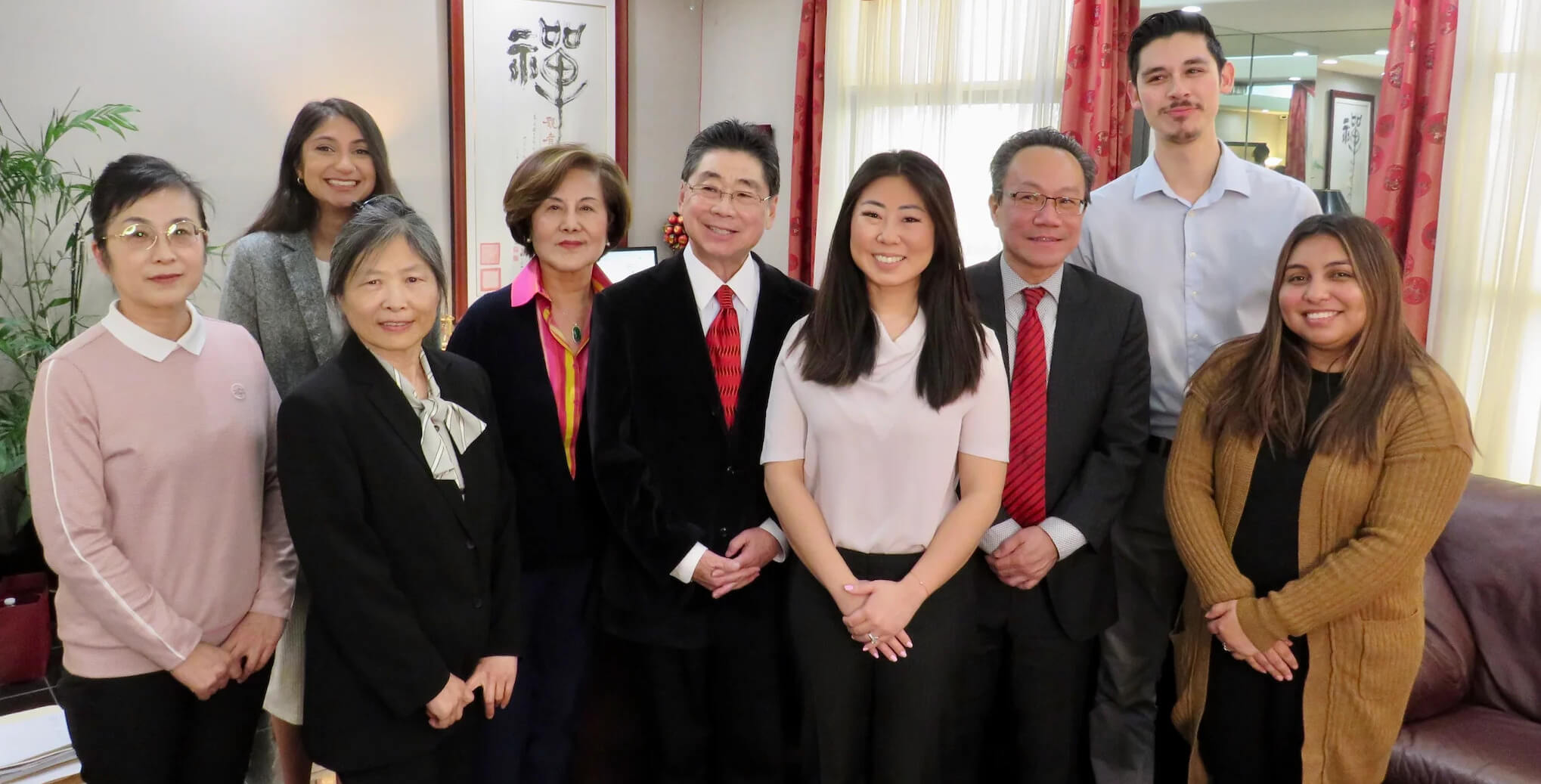

Why Choose Us?

  • Unmatched Expertise

    Trust in Peter Chu's 75+ years of collective experience to guide you through complex immigration matters.

  • Tailored Solutions

    Our personalized strategies adapt to your unique circumstances, ensuring we meet your specific immigration needs.

  • Proven Success

    Benefit from our solid track record in achieving favorable outcomes in various immigration cases across San Diego.

  • Dedicated Service

    Experience our client-first approach that ensures constant support and guidance throughout your immigration journey.

Chino, CA sits at the crossroads of the Inland Empire's growing immigrant population. San Bernardino County issued over 3,200 family-based visa approvals in 2024, making it one of Southern California's highest-volume jurisdictions for spousal immigration cases. For Chino residents navigating the K-3 spouse visa process, the difference between a six-month approval and a two-year delay often comes down to whether the I-129F petition was filed with complete supporting evidence before USCIS requested additional documentation. Law office of Peter Darwin Chu has handled K-3 spouse visa petitions for Chino families since founding, bringing California state bar compliance and direct experience with the USCIS California Service Center's evolving documentary standards.

Book a Consultation

Law office of Peter Darwin Chu provides k-3 attorney chino services to residents throughout Chino, CA. Licensed under the California State Bar with same-week consultation availability for K-3 spouse visa petitions, I-129F filing preparation, and consular interview readiness. We serve clients across all Chino zip codes (91708, 91709, 91710) and coordinate directly with the National Visa Center and U.S. consulates abroad. Our K-3 practice focuses exclusively on reuniting married couples separated by immigration status, ensuring every petition meets current USCIS documentary and evidentiary standards before submission.

K-3 Attorney Chino Service Area: Comprehensive Coverage Across San Bernardino County

Law office of Peter Darwin Chu represents K-3 spouse visa applicants throughout Chino, CA, including neighborhoods near Chino Hills State Park, El Prado, and the Preserve at Chino developments. Serving zip codes 91708, 91709, and 91710. We maintain familiarity with San Bernardino County court procedures for marriage certificate authentication and work closely with clients in surrounding Inland Empire communities whose cases are processed through the same USCIS California Service Center. All K-3 consultations are conducted by California-licensed immigration attorneys who understand the specific documentary requirements for spousal petitions filed from this region.

What Chino K-3 Spouse Visa Clients Can Access

K-3 Nonimmigrant Visa Petition (Form I-129F)

The K-3 visa allows the foreign spouse of a U.S. citizen to enter the United States while the immigrant visa petition (Form I-130) is pending. Our Chino k-3 attorney service includes complete I-129F preparation, evidence compilation (proof of bona fide marriage, financial support documentation, and civil documents), and submission to USCIS with tracking. We coordinate timing between the I-130 and I-129F filings to maximize processing efficiency. Critical in 2026 as USCIS continues implementing the April 2024 policy memo prioritizing cases with complete initial evidence. Most Chino clients schedule an initial consultation within 48 hours of contact.

Consular Processing and Interview Preparation

Once USCIS approves the I-129F petition, the case transfers to the National Visa Center and then to the U.S. consulate in your spouse's home country. We provide country-specific consular interview preparation, document translation coordination, and Affidavit of Support (Form I-864) review. For Chino families with spouses abroad in the Philippines, Mexico, or India. The three most common countries of origin in San Bernardino County K-3 cases. We maintain updated knowledge of each consulate's current processing times and documentary preferences. Consultation includes a pre-interview checklist and mock interview session.

Adjustment of Status After K-3 Entry

The K-3 visa is a bridge to lawful permanent residence. After your spouse enters the U.S. on a K-3 visa, we file Form I-485 (Adjustment of Status) along with work authorization (Form I-765) and travel permission (Form I-131). Our Ir-1 Spouse Visa page provides additional context on immigrant visa pathways for married couples. Most K-3 holders receive employment authorization within 90–120 days of I-485 filing, allowing immediate workforce participation in Chino's logistics, healthcare, and retail sectors while the green card application is pending.

Get clear, expert legal guidance tailored to your visa, green card, or citizenship needs.

Licensed K-3 Immigration Attorney Serving Chino, CA

Law office of Peter Darwin Chu maintains all required California State Bar licenses and operates in full compliance with American Immigration Lawyers Association (AILA) ethical standards and the California Rules of Professional Conduct governing attorney-client privilege and conflict-of-interest disclosure. We provide written fee agreements before any representation begins, as required under California Business and Professions Code Section 6148 for immigration cases exceeding $1,000 in total cost. Every K-3 petition filed from our Chino practice includes a compliance review against the current USCIS Policy Manual Volume 6 (Immigrants) and Volume 12 (Citizenship and Naturalization) to ensure evidentiary sufficiency before submission. Chino clients receive case status updates every 30 days and direct attorney access via secure client portal.

Inquire now to check if you qualify

What if my I-130 petition for my spouse was already filed — can I still apply for a K-3 visa in Chino?

Yes. The K-3 visa was specifically designed for spouses who already have a pending I-130 immigrant visa petition. You file Form I-129F (the K-3 petition) after the I-130 receipt notice is issued but before the I-130 is fully approved. In practice, as of 2026, USCIS processes I-130 spousal petitions faster than in prior years, which has reduced K-3 usage. But the K-3 remains valuable when the I-130 is delayed due to administrative processing or when the foreign spouse is in a country with long immigrant visa interview wait times. For Chino residents whose spouse is abroad in a country with consular backlogs exceeding 12 months, the K-3 can reduce total separation time by 6–9 months. We evaluate your specific I-130 filing date and current processing time to determine whether a K-3 filing is strategically advantageous.

What if my spouse entered the U.S. on a tourist visa — can we still use the K-3 process in Chino?

If your spouse is already in the United States on a B-2 tourist visa or visa waiver, the K-3 process is not necessary. You proceed directly with adjustment of status (Form I-485) based on the approved or pending I-130 petition. The K-3 visa is only for spouses who are outside the United States and waiting abroad. However, if your spouse's tourist visa is expiring soon or they entered with the preconceived intent to remain permanently (which can trigger visa fraud findings), you need an immigration attorney review before filing anything. Chino residents in this scenario should schedule a consultation immediately. Adjustment of status filings from tourist status carry higher scrutiny and require careful documentation of the timeline between entry and marriage.

What if we got married abroad and the marriage certificate is not in English — how do we handle that for a K-3 petition in Chino?

All foreign-language documents submitted to USCIS. Including marriage certificates, birth certificates, and divorce decrees. Must be accompanied by a certified English translation. The translator must certify that they are competent in both languages and that the translation is accurate and complete; USCIS does not require the translator to be a professional or accredited service, but the certification statement must follow the format specified in 8 CFR 103.2(b)(3). For Chino k-3 spouse visa clients, we coordinate translation through vetted providers familiar with USCIS formatting requirements and ensure that the original foreign certificate, the translation, and the translator's certification statement are all included in the I-129F filing packet. Marriage certificates from Mexico, the Philippines, and China. The three most common countries in our Chino K-3 cases. Also require apostille or consular authentication depending on whether the country is a Hague Convention signatory.

What if my spouse has a prior immigration violation or overstay — does that disqualify them from a K-3 visa in Chino?

A prior overstay or unlawful presence can trigger inadmissibility bars under INA Section 212(a)(9), which may require a waiver (Form I-601) before a K-3 visa can be issued. If your spouse overstayed a prior U.S. visa by more than 180 days, they face a 3-year bar; overstays exceeding one year trigger a 10-year bar. These bars apply when the foreign national departs the United States and seeks to re-enter. Which is exactly what happens in a K-3 case. However, immediate relatives of U.S. citizens (which includes spouses) are eligible for the provisional unlawful presence waiver (Form I-601A) if the only ground of inadmissibility is unlawful presence. Chino residents with spouses who have overstay history should consult an immigration attorney before filing any petition. The waiver must be approved before the consular interview, or the visa will be denied and your spouse will be barred from re-entry for the duration of the penalty period.

K-3 Attorney Chino: Comparing Your Options

Chino residents pursuing spousal immigration have several paths. Each with different timelines, costs, and risks. K-3 nonimmigrant visas, CR-1/IR-1 immigrant visas, and adjustment of status from within the U.S. all lead to the same end goal (lawful permanent residence for the spouse), but the procedural route and waiting period differ significantly. Here's the honest answer: in 2026, the K-3 visa is rarely faster than direct consular processing of an immigrant visa, because USCIS now processes I-130 petitions for immediate relatives in 10–14 months on average. Comparable to or faster than K-3 processing times. However, the K-3 remains strategically valuable in two scenarios: when the foreign spouse is in a country with severe consular backlogs (e.g., Mexico, Philippines, India), where adding the K-3 option can reduce total wait time by allowing earlier interview scheduling, and when the U.S. citizen petitioner has an urgent need to reunite with their spouse before the I-130 is fully adjudicated.

OptionTimelineWork AuthorizationProfessional Assessment
K-3 Visa (Nonimmigrant)12–18 months (I-129F + consular processing)Available after entry via I-765 (3–4 months)Best for spouses abroad in high-backlog countries or cases where U.S. petitioner needs spouse present before I-130 approval; requires dual filing with I-130.
CR-1/IR-1 Visa (Immigrant)10–16 months (I-130 + consular processing)Immediate upon entry (green card holder)Faster to permanent residence than K-3 in most cases as of 2026; spouse enters as lawful permanent resident, no adjustment of status required.
Adjustment of Status (I-485)8–12 months if spouse already in U.S.Available via I-765 concurrent filing (3–4 months)Most efficient path if spouse is already lawfully present in the U.S.; requires valid nonimmigrant status or visa waiver entry within 90 days of filing.
DIY Petition (No Attorney)Same USCIS timeline, but 2–3x higher RFE rateSame availability, but delayed by documentation errorsRequest for Evidence (RFE) rate for pro se K-3 filers exceeds 40% according to AILA 2024 data; each RFE adds 3–6 months to processing.

Get in touch

Frequently Asked Questions

Find answers to common questions about our services

  • The K-3 visa process for Chino residents currently takes 12–18 months from I-129F filing to visa issuance, though this timeline varies by the foreign spouse's country of residence and the U.S. consulate's workload. USCIS processing of Form I-129F averaged

  • A K-3 petition requires: Form I-129F with filing fee, proof of U.S. citizenship (passport or birth certificate), proof of valid marriage (certified marriage certificate with translation if not in English), proof of termination of any prior marriages (divo

  • Yes. But not immediately. A foreign spouse who enters the United States on a K-3 visa must apply for work authorization by filing Form I-765 (Application for Employment Authorization Document) after arrival. Once filed, USCIS typically issues an EAD withi

  • If the I-130 immigrant visa petition is approved and processed faster than the K-3 petition (which increasingly happens in 2026), the K-3 application becomes moot. Your spouse proceeds directly with consular processing for an immigrant visa (CR-1 or IR-1)

  • You are not legally required to hire an immigration attorney to file a K-3 petition. USCIS accepts pro se (self-filed) applications. However, the K-3 process involves dual filings (both I-130 and I-129F), strict documentary requirements, and a high rate o

  • Yes. Unmarried children under 21 of the foreign spouse can apply for K-4 visas, which are derivative visas tied to the K-3 petition. The K-4 application is filed simultaneously with the K-3 petition on the same Form I-129F by listing each child in Part 2

  • As of 2026, the USCIS filing fee for Form I-129F is $535, which must be paid at the time of filing. After USCIS approval, additional fees are required: the National Visa Center processing fee is $120, and the consular visa application fee (Form DS-160) is

  • The K-1 visa is for engaged couples who plan to marry within 90 days of the foreign fiancé's arrival in the U.S.; the K-3 visa is for couples who are already legally married and the foreign spouse is waiting abroad while the immigrant visa petition (I-130

Need Personalized Immigration Guidance?

Law office of Peter Darwin Chu is a California-licensed k-3 attorney chino providing K-3 spouse visa representation to Chino, CA residents with same-week consultation scheduling, complete I-129F preparation, consular interview readiness coaching, and post-entry adjustment of status filing for foreign spouses seeking lawful permanent residence.

Related Immigration Services for Chino Residents

If you are exploring spousal immigration options beyond the K-3 visa, our Ir-1 Spouse Visa page provides detailed guidance on direct consular processing for immigrant visas. Often a faster path to permanent residence in 2026. Chino residents with spouses already in the United States should review our Citizenship service page for naturalization eligibility after obtaining permanent residence. We also represent clients in employment-based visa categories. Including O-1 Visa Lawyer San Diego for individuals with extraordinary ability and Expert H-1 Visa Lawyer San Diego for specialty occupation workers. For immediate consultation on your specific K-3 spouse visa case in Chino, contact our office today.

Speak With Us Today