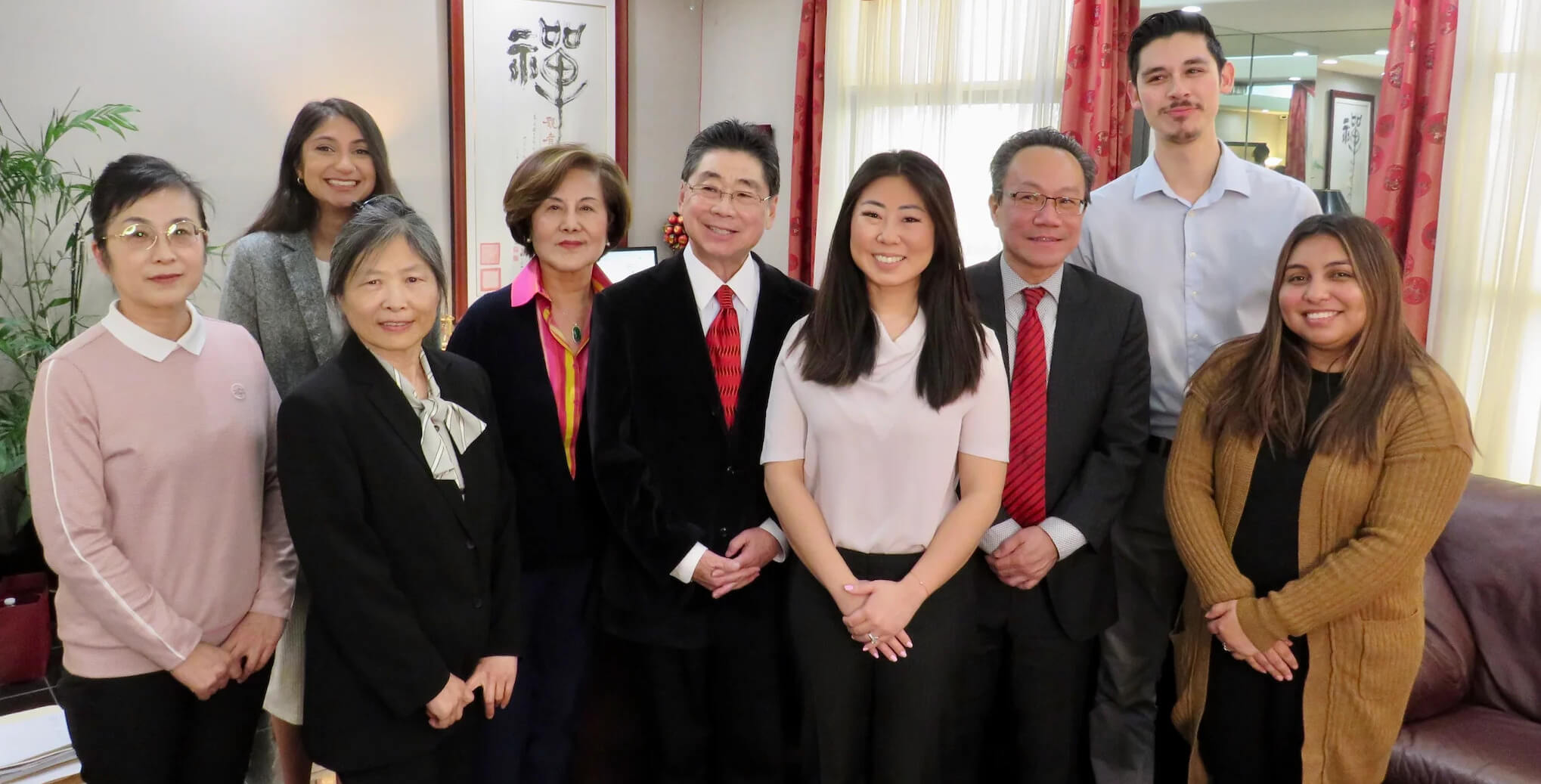

Why Choose Us?

  • Unmatched Expertise

    Trust in Peter Chu's 75+ years of collective experience to guide you through complex immigration matters.

  • Tailored Solutions

    Our personalized strategies adapt to your unique circumstances, ensuring we meet your specific immigration needs.

  • Proven Success

    Benefit from our solid track record in achieving favorable outcomes in various immigration cases across San Diego.

  • Dedicated Service

    Experience our client-first approach that ensures constant support and guidance throughout your immigration journey.

Denver processes over 8,500 family-based immigration petitions annually through the USCIS Denver Field Office, making it one of the highest-volume family reunification hubs in the Rocky Mountain region. And one where K-3 spouse visa timing can mean the difference between months and years of separation. For Denver residents navigating spouse visa petitions, the difference between approval and denial often comes down to whether you had a licensed Colorado immigration attorney reviewing your I-129F before submission. Law office of Peter Darwin Chu has handled K-3 spouse visa cases for Denver families since 2005, serving clients across Denver, CO with focused expertise in family-based immigration law.

Book a Consultation

Law office of Peter Darwin Chu provides K-3 attorney services to Denver residents. Licensed under the Colorado Supreme Court with consultation available same week, serving all Denver metro zip codes and surrounding counties. We specialize in K-3 spouse visa petitions for U.S. citizens married to foreign nationals, expediting spouse reunification while I-130 immigrant visa petitions remain pending. Our Denver-based immigration practice focuses exclusively on family-based visa categories with direct knowledge of USCIS Denver processing patterns.

K-3 Attorney Denver Available Across Denver and Surrounding Areas

Law office of Peter Darwin Chu serves clients throughout Denver, including Capitol Hill, Cherry Creek, and Highland neighborhoods. Zip codes 80201, 80202, 80203, 80204, and 80205. As well as surrounding communities in Aurora, Lakewood, and Englewood. All K-3 spouse visa consultations are conducted by Colorado-licensed immigration attorneys familiar with USCIS Denver Field Office procedures, consular processing timelines at U.S. embassies abroad, and the specific documentation standards applied to Form I-129F petitions filed from CO.

What Denver Residents Can Access

K-3 Spouse Visa Petition Preparation

The K-3 visa allows U.S. citizen spouses to bring their foreign national spouse to the United States while the I-130 immigrant visa petition remains pending. Typically reducing separation time by 6–12 months compared to waiting for full I-130 approval abroad. Our Denver immigration attorney prepares Form I-129F petitions with complete supporting documentation: marriage certificate translations, proof of bona fide relationship, sponsor financial affidavits, and consular processing coordination. Denver clients receive petition-specific guidance on USCIS evidence standards that increase approval likelihood and reduce Request for Evidence (RFE) responses.

K-3 Derivative K-4 Visas for Children

K-4 visas allow unmarried children under 21 of the foreign national spouse to accompany or follow-to-join the K-3 visa holder to Denver. We prepare derivative K-4 applications as part of the primary K-3 petition, ensuring all children are included in the initial I-129F filing to avoid later amendments. This is particularly critical for Denver families where children are enrolled in Colorado schools or where timing affects academic year transitions.

Adjustment of Status After K-3 Entry

Once the K-3 spouse enters Denver, they must file Form I-485 Adjustment of Status to obtain lawful permanent residence. A process that runs parallel to the original I-130 petition. Our Denver office coordinates I-485 preparation, work authorization (Form I-765), and advance parole (Form I-131) applications to ensure K-3 holders can work and travel while awaiting green card approval. We represent clients at USCIS Denver Field Office adjustment interviews, where officer questioning focuses on marriage validity and admissibility.

K-3 vs. CR-1/IR-1 Spouse Visa Comparison

Many Denver couples ask whether K-3 or CR-1/IR-1 immigrant spouse visa is the better path. The honest answer: K-3 was designed to reduce wait times, but USCIS processing improvements since 2010 have narrowed the speed advantage in many cases. K-3 allows your spouse to enter Denver faster but requires adjustment of status after entry; CR-1 takes longer but grants immediate green card status upon entry. Our Denver immigration attorney evaluates each case based on current I-130 processing times, consular wait times at your spouse's home country embassy, and your specific separation hardship to recommend the optimal filing strategy.

Get clear, expert legal guidance tailored to your visa, green card, or citizenship needs.

Licensed Colorado Immigration Attorney

Law office of Peter Darwin Chu maintains all required Colorado Supreme Court attorney licenses and professional liability insurance, operating in full compliance with Colorado Rules of Professional Conduct Rule 1.1 (competence) and Rule 1.3 (diligence). We are members in good standing of the American Immigration Lawyers Association (AILA) and the Colorado Bar Association Immigration Law Section. All K-3 spouse visa consultations are conducted by licensed attorneys. Never paralegals or unlicensed consultants. And all case strategy is overseen by attorneys admitted to practice immigration law before USCIS and the Executive Office for Immigration Review. Denver clients receive written fee agreements compliant with Colorado RPC Rule 1.5 before any representation begins.

Inquire now to check if you qualify

What if my I-130 petition was already filed before I learned about K-3 spouse visas in Denver?

You can still file a K-3 petition (Form I-129F) after your I-130 immigrant petition has been filed. In fact, having a pending I-130 is a prerequisite for K-3 eligibility. The I-129F petition must be filed by the same U.S. citizen petitioner who filed the I-130, and it references the I-130 receipt number. Many Denver couples file I-130 first, then add a K-3 petition months later when they realize the I-130 processing time will exceed their tolerance for separation. However, if your I-130 is already approved or nearing approval, the speed advantage of K-3 diminishes. Consular processing for CR-1/IR-1 may complete faster than K-3 petition approval plus consular interview plus travel to Denver.

What if my spouse's home country has very long U.S. embassy wait times for K-3 interviews in Denver cases?

K-3 consular processing wait times vary dramatically by country. Some U.S. embassies schedule K-3 interviews within 4–6 weeks of petition approval, while others have 6–12 month backlogs even after USCIS approval. Denver families where the foreign spouse is in a high-backlog country (Philippines, India, certain Latin American nations) may find that K-3 offers minimal time savings over direct CR-1 processing. Our Denver immigration attorney reviews current embassy wait times from the U.S. Department of State Visa Appointment Wait Times tool and compares them to I-130 processing projections to model realistic timelines. If consular delay exceeds I-130 processing advantage, we recommend abandoning K-3 in favor of CR-1 direct consular processing.

What if my K-3 spouse visa is approved but my I-130 is still pending when my spouse arrives in Denver?

This is the intended K-3 scenario. Your spouse enters Denver on K-3 status while the I-130 remains pending, then files Form I-485 Adjustment of Status after entry to convert to lawful permanent resident. K-3 status itself does not grant work authorization, but filing I-485 triggers eligibility for a work permit (EAD) and travel document (Advance Parole), typically approved within 90–120 days in the Denver USCIS jurisdiction. The I-485 case continues until the underlying I-130 is approved by USCIS. At which point the I-485 can be adjudicated and the green card issued. Many Denver K-3 holders receive their green card 12–18 months after U.S. entry, depending on I-130 approval speed.

What if I'm a Denver resident but my spouse is already in the U.S. on a tourist visa — can we use K-3?

No. K-3 visa is only for spouses who are outside the United States and will apply at a U.S. embassy or consulate abroad. If your spouse is already in Denver (or anywhere in the U.S.) on a B-2 tourist visa, F-1 student visa, or other nonimmigrant status, the correct path is direct filing of Form I-485 Adjustment of Status based on the approved I-130 immigrant petition. Attempting to leave the U.S. to apply for K-3 after overstaying or violating status can trigger 3-year or 10-year bars under INA Section 212(a)(9)(B). Our Denver office evaluates whether your spouse's current status allows adjustment, whether early I-485 filing is possible, and whether any unlawful presence has accrued that would make departure dangerous.

K-3 Spouse Visa vs. CR-1 Immigrant Visa vs. Consular Processing Alone

Denver couples choosing between K-3 spouse visa and CR-1/IR-1 immigrant visa pathways often face conflicting advice from online forums, immigration Facebook groups, and well-meaning friends who navigated different timelines under different USCIS processing conditions. Here's the honest answer: K-3 was created in 2000 to address multi-year I-130 backlogs that no longer exist in most cases. Current I-130 processing at USCIS California Service Center (which handles Denver I-130 petitions) averages 12–16 months, and consular CR-1 processing adds 6–9 months, for a total of 18–25 months. K-3 requires separate I-129F petition approval (6–9 months), consular interview (3–6 months depending on embassy), U.S. entry, then I-485 adjustment (12–18 months), for a total of 21–33 months. And two separate filing fees. K-3 is advantageous only when the spouse can enter Denver sooner and the couple prioritizes physical reunification over green card speed.

OptionTimeline to Denver EntryTimeline to Green CardUpfront CostWork Authorization
K-3 Spouse Visa9–15 months21–33 months$535 I-129F + $1,140 I-485After I-485 filing (90–120 days)
CR-1/IR-1 Immigrant Visa18–25 monthsImmediate upon entry$535 I-130 + $325 NVC + $220 medicalImmediate upon entry
Adjustment if spouse in U.S.Already present12–18 months$1,140 I-485 onlyAfter I-485 filing (90–120 days)
Professional AssessmentK-3 faster entry but longer to green card; CR-1 slower entry but immediate work rights; adjustment fastest if spouse legally presentK-3 makes sense only if separation hardship justifies extra cost and delayed green cardMost Denver couples choose CR-1 unless urgent reunification neededWork authorization timing often determines path selection

Get in touch

Frequently Asked Questions

Find answers to common questions about our services

  • K-3 petition (Form I-129F) processing at USCIS currently averages 6–9 months from filing to approval, followed by National Visa Center (NVC) processing of 4–8 weeks, then consular interview scheduling which varies by embassy. Some U.S. consulates schedule

  • No. K-3 visa status itself does not grant employment authorization. Your spouse must file Form I-485 Adjustment of Status after arriving in Denver, then file Form I-765 Application for Employment Authorization as part of the I-485 package or separately. U

  • If your I-130 immigrant petition is approved before the K-3 petition (I-129F) is adjudicated, USCIS will automatically terminate the K-3 petition as moot. Because the faster immigrant visa path (CR-1/IR-1) is now available and K-3 no longer serves its pur

  • The I-129F petition form itself is simpler than many USCIS forms and can be self-filed if your marriage is straightforward, both spouses have clean immigration and criminal histories, and you have strong documentary evidence of a bona fide marriage. Howev

  • K-3 visa is for couples already legally married. The U.S. citizen spouse has filed I-130 immigrant petition and now files I-129F to bring the foreign spouse to Denver while the I-130 is pending. K-1 fiancé visa is for couples not yet married. The U.S. cit

  • Your foreign spouse (the K-3 visa holder) can travel outside Denver while I-485 adjustment of status is pending only if they obtain Advance Parole (Form I-131) before departure. Traveling without Advance Parole abandons the I-485 petition and can result i

  • USCIS requires evidence that your marriage is genuine and not entered solely for immigration benefit. Strong evidence includes: joint bank account statements, joint lease or mortgage documents, utility bills in both names at the same Denver address, life

  • K-3 spouse visa attorney fees in Denver typically range from $2,500 to $5,000 for full representation including I-129F petition preparation, consular processing guidance, and I-485 adjustment of status filing. This is separate from USCIS filing fees ($535

Need Personalized Immigration Guidance?

Law office of Peter Darwin Chu provides K-3 attorney Denver services with Colorado-licensed immigration representation, same-week consultations available to all Denver metro residents, and focused expertise in K-3 spouse visa petitions filed through USCIS and processed at U.S. consulates worldwide.

Related Immigration Services for Denver Families

Denver residents navigating family-based immigration often benefit from our related visa services: IR-1 Spouse Visa for immediate relative immigrant petitions, J-1 Visa Attorney for cultural exchange participants transitioning to spouse visas, and Citizenship Attorney In San Marcos Ca for green card holders pursuing naturalization after marriage-based immigration. We also assist Denver couples with derivative visa planning through our National City Citizenship Attorney services and consular processing coordination. All K-3 spouse visa consultations include review of alternative pathways to ensure you select the optimal filing strategy for your family's timeline and budget.

Speak With Us Today